Ingredients
Ceramides, panthenol and squalane support skin in different ways, combining structure, hydration and softness within one balanced formula.
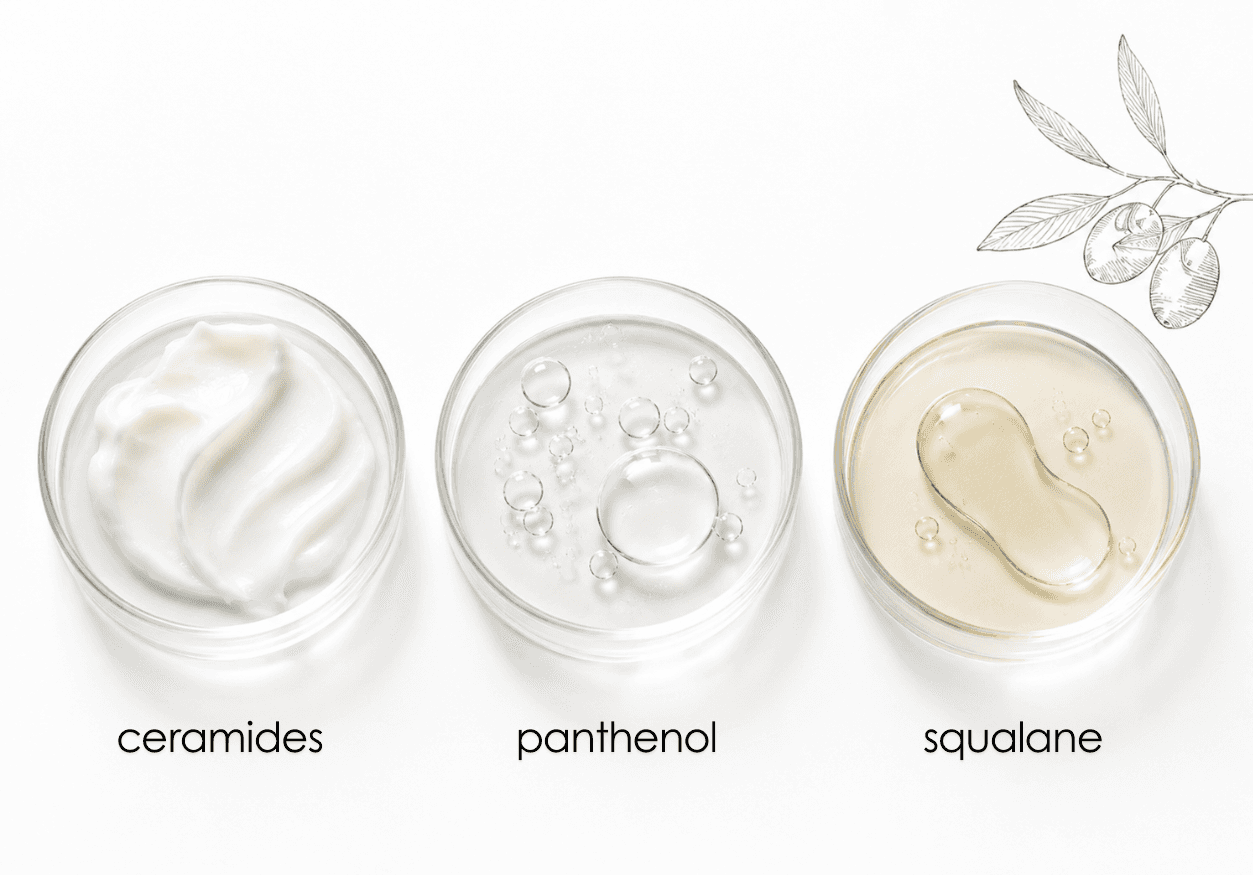
Ceramides, panthenol and squalane are often grouped together as barrier ingredients.
But they are not interchangeable.
One contributes to the skin’s lipid organisation. One improves hydration and comfort. One acts primarily as a softening emollient.
Their value comes from doing different jobs well.
Ceramides support structure
Ceramides are naturally present within the lipid matrix of the stratum corneum, alongside cholesterol and free fatty acids. Together, these lipids form organised layers that help limit water loss and reduce the passage of external substances through the skin.
The familiar bricks and mortar comparison is useful, but incomplete. Ceramides do not simply glue skin cells together. Their type, proportion and arrangement with other lipids influence how effectively the barrier performs.
This is also why adding ceramides to a product does not automatically make it a superior barrier formula.
Research suggests that ceramide containing preparations can improve dryness and barrier measurements, particularly in atopic skin, but performance depends on concentration, supporting lipids and the complete formulation.
Ceramides provide the material. Formulation determines whether that material is organised effectively.
Panthenol supports hydration and recovery
Panthenol, also called dexpanthenol, is a derivative of vitamin B5 commonly used in moisturising and soothing products.
Controlled studies have found that topical dexpanthenol can increase hydration in the stratum corneum, reduce transepidermal water loss and improve softness. It has also shown benefits in models of irritation and barrier recovery.
It is sometimes described as drawing water into the deeper layers of skin or directly instructing the skin to produce more lipids. Those explanations go further than the available evidence supports.
Its most defensible role is simpler:
• It helps improve surface hydration
• It supports a more comfortable skin feel
• It may assist recovery when the skin has been irritated
Panthenol is valuable not because it performs one dramatic action, but because it improves several small conditions that allow skin to feel better.
Squalane supports softness
Squalane is the stable, hydrogenated form of squalene, a lipid naturally found in human sebum.
The extra letter matters.
Squalene is more vulnerable to oxidation. Squalane is more stable, which makes it better suited to cosmetic formulas.
On the skin, squalane functions mainly as an emollient. It spreads across the surface, reduces roughness and improves softness and flexibility. Evidence for squalene and related materials also supports their use in topical vehicles and moisturising systems.
Squalane does not make skin breathe, because skin does not breathe through its surface in the way lungs do. It also does not perfectly copy natural sebum.
Its advantage is practical.
It can provide slip and softness without the dense or waxy feel associated with some richer emollients.
Why they work well together
These ingredients are useful as a trio because they approach moisture from different directions.
Ceramides: support the lipid organisation involved in limiting water loss
Panthenol: improves hydration and comfort
Squalane: softens the surface and improves flexibility
That does not create a universal formula for repair. The ratio of ingredients, the delivery system and everything surrounding them still matter.
A moisturiser with all three can be poorly designed.
A moisturiser without all three can still perform beautifully.
Ingredient recognition is only the beginning. The real intelligence lies in how the formula arranges those ingredients into a texture the skin can comfortably use.
Ceramides build context. Panthenol improves conditions. Squalane refines the feel.
Together, they do not replace the skin’s natural functions.
They support the environment in which those functions take place.
Shop our Barrier Balance Moisturizer