Misconceptions
Natural describes where an ingredient came from, not how safe, gentle or effective it will be on the skin.
Natural is one of skincare’s most persuasive words.
It suggests purity, simplicity and a formula closer to what the skin already understands. Synthetic ingredients, by contrast, are often presented as artificial or unnecessarily harsh.
But safety is not determined by whether an ingredient began in a plant or a laboratory.
It is determined by its identity, purity, concentration, stability, route of exposure and how it behaves inside the finished formula.
Origin tells you where an ingredient came from. It does not tell you what that ingredient will do.
Plants contain active chemistry too
Botanical ingredients are not chemically simple.
A plant extract may contain dozens or even hundreds of compounds, some useful, some inactive and some capable of causing irritation or allergy.
Reviews of cosmetic contact dermatitis have identified ingredients such as tea tree oil, peppermint, lavender and extracts from certain plant families as possible allergens. Essential oils and botanical extracts are therefore not automatically suitable for sensitive skin.
This does not make plant ingredients unsafe as a group.
It means they should be evaluated with the same care as every other cosmetic ingredient.
Natural fragrance is still fragrance
Fragrance molecules can come from flowers, fruit peels, resins or laboratory synthesis.
The skin does not become less capable of reacting because the fragrance was extracted from a plant.
Natural essential oils can contain recognised fragrance allergens and may cause allergic contact dermatitis in susceptible people. Oxidation during storage can also change certain fragrance compounds and increase their sensitising potential.
A botanical scent may smell softer. Its source does not make it biologically invisible.
Synthetic does not mean dangerous
A synthetic ingredient is produced or modified through controlled chemical processes.
That can offer practical advantages:
• More consistent purity between batches
• Better control over concentration
• Greater stability
• Fewer unpredictable plant components
• Easier testing and standardisation
Some laboratory produced ingredients are chemically identical or very similar to substances found naturally in the skin or elsewhere in nature.
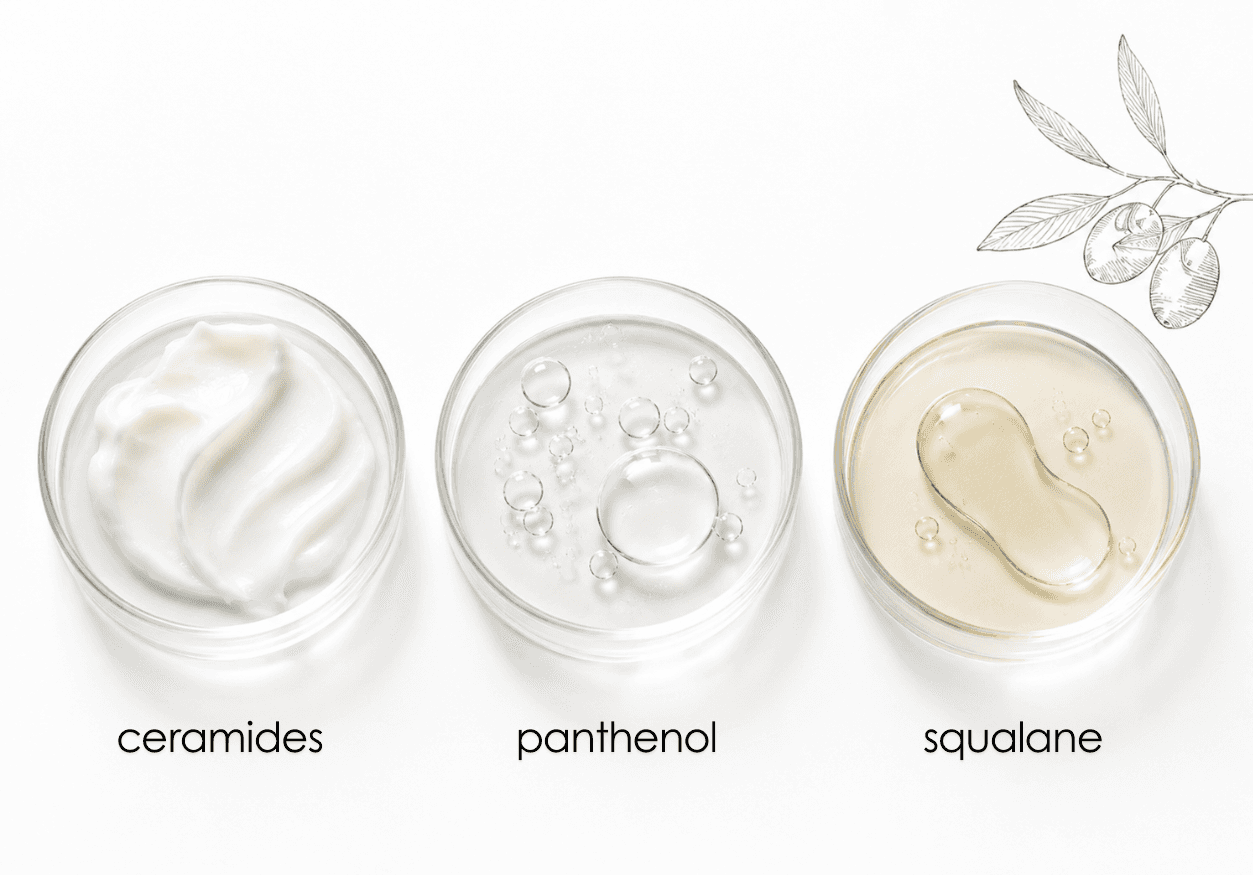
Glycerin, ceramides and panthenol do not become less useful because a manufacturer can produce them consistently at scale.
Likewise, a naturally sourced ingredient is not automatically superior when its composition varies with harvest, soil, climate or extraction method.
Dose changes the answer
Even water can damage skin under the wrong conditions.
Safety cannot be judged from an ingredient name alone. Concentration, frequency, contact time and application area all matter.
A plant extract may be comfortable at one level and irritating at another. A synthetic preservative may be safe and essential at its approved concentration, while helping prevent microbial contamination of the entire product.
Removing preservatives simply to make a formula appear more natural can create another safety problem. Some products marketed as completely natural may also have shorter shelf lives when their ingredients support microbial growth.
The safest formula is not the one with the fewest unfamiliar words. It is the one designed to remain safe throughout its use.
Preservatives are not unnecessary chemicals
Water based skincare can support the growth of bacteria, yeast and mould.
Preservatives help protect the product during manufacturing, storage and repeated contact with fingers, air and bathroom humidity.
A preservative can cause allergy in some users, but that does not make preservation optional. The formulation challenge is to choose an effective system at an appropriate concentration while testing the finished product for stability and microbial safety.
A preservative free label may sound gentle.
A contaminated moisturiser is not.
Natural ingredients can still be excellent
Centella asiatica, colloidal oat, green tea and licorice derived compounds all have useful skincare research.
Their value comes from the specific compounds they contain, the extract used, its concentration and the quality of the completed formula.
Aloe taken directly from a leaf is not automatically equivalent to a purified, preserved and tested aloe ingredient inside a cosmetic product.
Similarly, a traditional history of use can support interest in an ingredient, but it cannot replace controlled evidence for the exact claim being made.
Read beyond the label
Words such as natural, organic and clean are not complete safety assessments.
The United States Food and Drug Administration states that an ingredient’s source does not determine its safety, and that natural or organic ingredients can still contain toxic or allergenic substances.
A more useful evaluation asks:
Is the ingredient relevant to the formula’s purpose?
Is it used at an appropriate concentration?
Is the product properly preserved and stable?
Are fragrance allergens present?
Has the complete formula been tested appropriately?
Does the product remain comfortable on your own skin?
Patch testing can help when introducing a new formula, but repeated or severe reactions may require professional allergy testing.
Formulation is more important than ideology
Skincare does not need to choose between nature and science.
Nature supplies valuable compounds. Science identifies, purifies, stabilises and tests them. Science also creates useful ingredients when natural sourcing would be inconsistent, inefficient or less stable.
Both natural and synthetic ingredients can be effective.
Both can irritate.
Both must earn their place through evidence and responsible formulation.
Safe skincare is not defined by how natural the label sounds. It is defined by how carefully the formula has been built, tested and used.