Seasonal Skin
Humidity can make skincare feel sticky by slowing evaporation and magnifying the film left behind by sweat, sunscreen and multiple product layers.

Humidity changes how skincare feels long before it changes what the formula is meant to do.
When the air already contains a high amount of water vapour, sweat evaporates less efficiently and watery products may take longer to settle. Add sunscreen, makeup and several skincare layers, and the surface can begin to feel tacky even when every product felt lightweight on its own.
Stickiness is usually not one bad ingredient. It is the total film created by formula, quantity, climate and sweat.
Humidity slows the disappearing act
Many skincare products contain water and other components that evaporate after application. What remains is a thin film of humectants, emollients, polymers, active ingredients and sunscreen filters.
High humidity can influence the adhesion and physical behaviour of both skin and topical creams. Research has shown that environmental humidity can affect cream film thickness and adhesive forces on the skin surface.
This helps explain why the same moisturiser may feel elegant in cooled indoor air, but noticeably tackier during a humid commute.
The product has not stopped absorbing.
More of its remaining film has simply become perceptible.
Humectants are not pulling too much water from the air
Glycerin and hyaluronic acid are often blamed for stickiness in humid weather because they attract water.
There is some truth beneath the claim. Humectants can influence how much water remains within a cosmetic film, and glycerin can slow the evaporation of water from an applied product.
But humectants do not simply flood the skin with atmospheric moisture.
Their feel depends on:
• Concentration
• Molecular size
• The amount applied
• Other film forming ingredients
• How many similar formulas are layered
• The surrounding temperature and humidity
A well balanced humectant formula can feel comfortable in humid weather. A concentrated or heavily layered one may remain tacky.
The ingredient is not automatically wrong for the climate. The formulation or quantity may be.
Sweat becomes part of the formula
Once applied, skincare does not remain isolated.
It mixes with sweat, sebum, sunscreen and anything else already on the surface. In hot and humid conditions, sweat stays noticeable for longer because evaporation is less efficient.
The American Academy of Dermatology recommends gently blotting sweat rather than rubbing it, particularly in hot weather, since friction can aggravate the skin.
This mixture can create:
• A glossy surface
• Increased slip
• Tackiness around the upper lip and hairline
• Sunscreen movement
• Makeup that separates or grips unevenly
• A feeling of heat beneath richer layers
Pores are not softening or opening in the humidity. The surface is simply becoming warmer, wetter and more coated.
Layering creates cumulative residue
A toner may leave almost no noticeable film.
A serum may also feel light.
The moisturiser and sunscreen may each apply beautifully.
But skincare is experienced cumulatively. Every layer leaves something behind, and humid weather makes that combined residue harder to ignore.
The solution is not necessarily to replace every product.
First, reduce the total load:
Use less of products that do not require a fixed protective amount
Remove duplicate hydrating layers
Allow one product to provide both hydration and treatment
Choose a lighter moisturiser when sunscreen already feels moisturising
Keep the correct sunscreen quantity, even if other steps need simplifying
Sunscreen should not be deliberately under applied to improve the finish. Broad spectrum, water resistant protection with SPF 30 or higher remains important, particularly when sweating outdoors.
Rich does not always mean sticky
Butters, waxes, silicones and oils can influence the weight and film of a formula, but none is automatically unsuitable for humidity.
A product may feel sticky because of a polymer, humectant system or sunscreen film even when it contains very little oil.
Likewise, a carefully structured cream can contain richer emollients and still settle comfortably.
Look beyond labels such as gel, cream or oil free.
Pay attention to the actual finish:
• Does it remain tacky after several minutes?
• Does it become uncomfortable only after sweating?
• Does it pill beneath sunscreen?
• Does reducing the quantity solve the problem?
• Does the stickiness begin only after the final layer?
Those answers reveal more than the product category.
There is no perfect waiting time
You do not need to wait exactly sixty or ninety seconds between every skincare step.
A layer only needs enough time to spread and settle so that the next product does not immediately move it around. The necessary time depends on the formula and quantity.
A practical method is simple:
Apply a thin, even layer.
When the surface no longer feels very wet or mobile, continue.
Long waiting periods cannot rescue an overloaded routine. If five layers remain sticky after ten minutes, time may not be the missing ingredient.
A smarter humid weather routine
Morning
Cleanse only as needed
Use one lightweight treatment or hydrating step
Add moisturiser only when the skin needs it
Apply the correct amount of sunscreen
During the day
Blot sweat gently with clean tissue or blotting paper
Avoid repeatedly rubbing or powdering wet skin
Reapply sunscreen after significant sweating or prolonged outdoor exposure
Evening
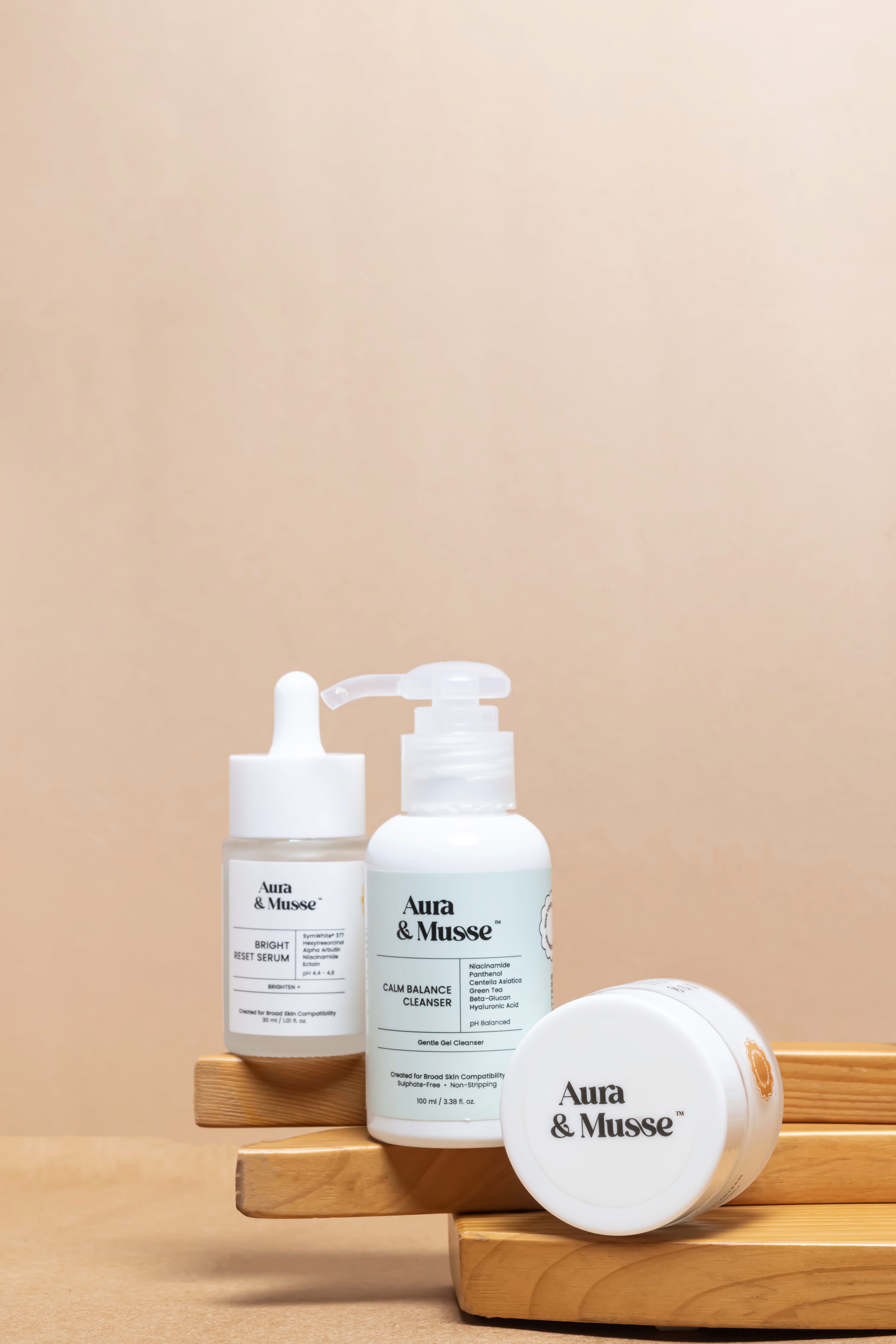
Cleanse away sunscreen, sweat and daily residue (Shop: Calm Balance Cleanser)
Use treatment only when required (Shop: Bright Reset Serum)
Finish with a moisturiser suited to how the skin feels indoors (Shop: Barrier Balance Moisturizer)
Oily skin may also benefit from water based or non comedogenic products, although these labels do not guarantee a completely dry or invisible finish.
The goal is not to make every product disappear.
It is to leave only the film the skin actually needs.
In humid weather, comfort often comes from fewer overlapping layers, smaller quantities and formulas that settle without competing with sweat.