Skin Rituals
Morning skincare prepares the skin for ultraviolet exposure and daily wear, while the evening routine removes accumulated products and creates space for treatments that are better used at night.

Morning and evening routines do not need completely different shelves.
The real difference is context.
During the day, skincare must sit beneath sunscreen, tolerate heat and movement, and remain comfortable alongside sweat, makeup and environmental exposure.
At night, sunscreen and daily residue need to be removed, and there is usually more freedom to use treatments or richer textures without considering how they will wear outdoors.
The clock does not transform the product. It changes what the product must work alongside.
Morning is built around protection
The most important distinction in a morning routine is ultraviolet exposure.
Sunscreen belongs at the end of daytime skincare because it helps protect against ultraviolet radiation, which contributes to sunburn, pigmentation, premature skin ageing and skin cancer. Dermatologists recommend a broad spectrum, water resistant sunscreen with SPF 30 or higher for daily outdoor protection.
A practical morning routine may include:
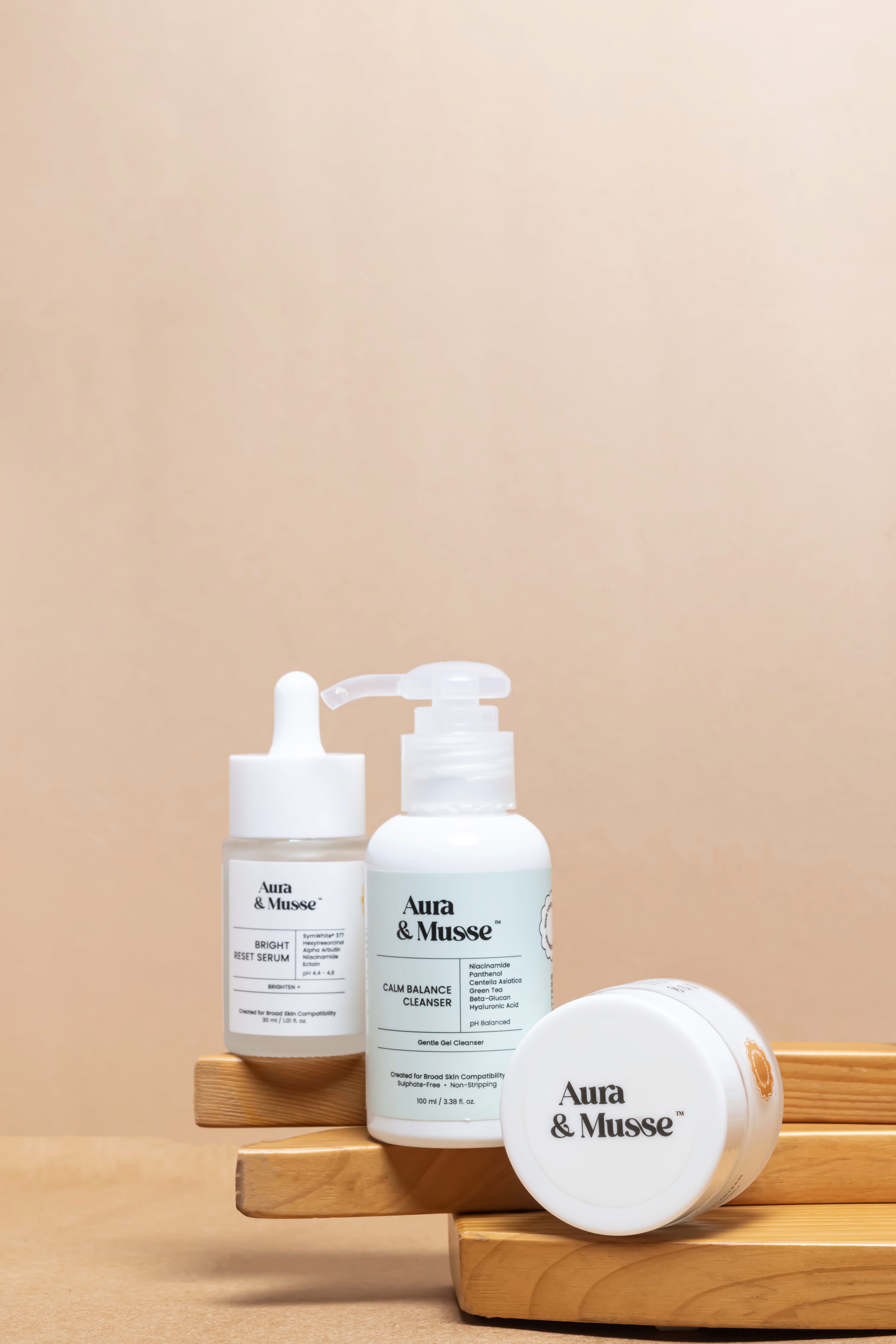
Gentle cleansing when needed (Shop: Calm Balance Cleanser)
One treatment or antioxidant serum (Shop: Bright Reset Serum)
Moisturiser according to comfort (Shop: Barrier Balance Moisturizer)
Sunscreen
Morning skincare does not need to defend the skin from every environmental molecule through a long sequence of products. Sunscreen, comfortable moisture support and a suitable treatment are usually more useful than several overlapping serums.
Evening begins with removal
By the end of the day, the skin may be carrying sunscreen, makeup, sweat, oil and skincare residue.
The evening routine therefore begins with cleansing that is effective enough for what was worn. One cleanse may be sufficient for a light routine. Water resistant sunscreen or makeup may require a more thorough method.
Night cleansing is not necessary because the skin becomes biologically dirty after sunset.
It is necessary because the products and residue accumulated during the day should not remain indefinitely.
Does skin enter repair mode at night?
Skin does follow circadian rhythms.
Processes such as temperature, blood flow, cell activity and barrier measurements can vary across the day and night. Sleep quality has also been associated with differences in barrier recovery and transepidermal water loss.
But the popular phrase “skin repairs itself only at night” is too simple.
Repair, renewal and immune activity continue throughout the day. Night is not a special window in which skincare suddenly becomes dramatically more effective.
Skin follows a rhythm. It does not wait for bedtime to begin functioning.
Is skin more receptive at night?
The claim that skin absorbs every ingredient better at night is not established as a universal rule.
Changes in skin temperature, blood flow and water loss may influence how the surface behaves, but product penetration still depends mainly on:
• Molecular size
• Concentration
• Delivery system
• Formula structure
• The condition of the skin
• How long the product remains in contact
A serum does not automatically penetrate more deeply simply because it was applied before sleep.
Nighttime is often chosen for treatments because it is practical, not because the skin unlocks after dark.
Why retinoids are usually used at night
Retinoids are commonly placed in evening routines.
Some retinoids are unstable when exposed to light, and these ingredients can also cause dryness, scaling and irritation. Reviews of topical retinoids recognise stability and irritation as important formulation challenges, while dermatology guidance commonly recommends applying retinoids before bed.
Night use also keeps the routine simpler beneath sunscreen and makeup.
This does not mean every retinoid is chemically destroyed the moment daylight touches it. Modern formulas differ, so the product instructions remain the most relevant guide.
Exfoliating acids are not automatically nighttime ingredients
Acids are often recommended at night because they can be easier to separate from other treatments and because certain exfoliating ingredients may increase sensitivity to ultraviolet exposure.
But an acid does not become safer merely because it is dark outside.
Concentration, pH, frequency and the rest of the routine still determine tolerability.
An exfoliating product formulated for morning use may be used as directed, provided sunscreen follows. A strong peel used at night can still cause significant irritation.
Timing can organise a routine. It cannot correct excessive strength.
Vitamin C can fit into either routine
Vitamin C is often applied in the morning because its antioxidant role complements sunscreen.
That does not mean it becomes ineffective at night.
The best time is when the formula remains stable, layers comfortably and can be used consistently. A sticky vitamin C serum that disrupts sunscreen may fit better into an evening routine, while an elegant daytime formula may work well beneath protection.
Function matters, but wearability matters too.
Night does not always require richer skincare
A night cream is not automatically more restorative than a daytime moisturiser.
Richer products may feel suitable at night because there is no sunscreen or makeup above them. They may also help when indoor cooling, retinoids or dry weather leave the skin tight.
But oily or congestion prone skin may prefer the same lightweight moisturiser morning and evening.
Choose texture according to:
• Current dryness
• Climate
• Active treatments
• Indoor humidity
• Personal comfort
The word night on the label does not create a different biological category of moisturiser.
Water loss can vary overnight
Research suggests that transepidermal water loss and other barrier measurements can fluctuate across the day. Sleep quality has also been associated with barrier recovery, although these findings do not mean every person requires a heavy cream before bed.
A suitable moisturiser may improve comfort overnight, particularly when the skin feels dry or when a treatment causes irritation.
The need comes from the skin and the formula, not simply from the hour.
What actually changes
Morning priorities
• Comfortable layering
• Antioxidant support when useful
• Moisturiser according to need
• Broad spectrum sunscreen
Evening priorities
• Removal of sunscreen and daily residue
• Targeted treatment when required
• Moisture support according to comfort
• Avoiding combinations that create unnecessary irritation
Many products can appear in both routines.
A cleanser, moisturiser or niacinamide serum does not need a separate daytime and nighttime identity when the same formula works well in both.
Morning skincare prepares the skin for exposure. Evening skincare removes what exposure left behind and makes room for treatment.
The difference is not protection versus repair in absolute terms.
It is the purpose, environment and product compatibility surrounding each application.